
Purple Coneflower
Echinacea purpurea
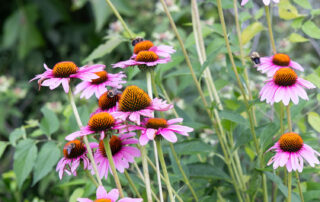
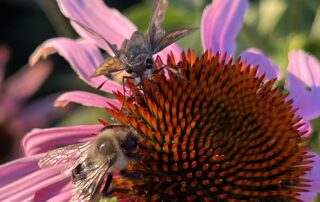
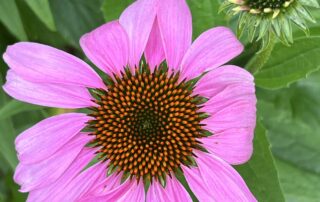
Echinacea purpurea is an herbaceous perennial up to 120 centimeters (47 inches) tall by 25 cm (10 in) wide at maturity. Depending on the climate, it blooms throughout summer into autumn. Its cone-shaped flowering heads are usually, but not always, purple in the wild. Its individual flowers (florets) within the flower head are hermaphroditic, having both male and female organs in each flower. It is pollinated by butterflies and bees. The alternate leaves, borne by a petiole from 0 to 17 cm (0 to 7 in), are oval to lanceolate, 5–30 cm (2–12 in) long by 5–12 cm (2–5 in) wide; the margin is tightened to toothed.
The inflorescence is a capitulum, 7 to 15 cm (3 to 6 in) in diameter, formed by a prominent domed central protuberance consisting of multiple small yellow florets. These are surrounded by a ring of pink or purple ligulate florets. The tubular florets are hermaphrodite while the ligular florets are sterile. The involucral bracts are linear to lanceolate. The plant prefers well-drained soils in full sun. The fruit is an achene, sought after by birds.